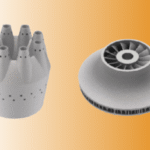
Revolutionizing Aerospace with Alloy Powders

3D-printed alloys revolutionize aerospace engineering by enabling lightweight, high-strength components with unprecedented design freedom. Key alloys like titanium (Ti-6Al-4V), nickel-based superalloys (Inconel 718), and aluminum-scandium are processed via laser powder bed fusion (LPBF) or electron beam melting (EBM) to create complex geometries impossible with traditional methods. Applications include:

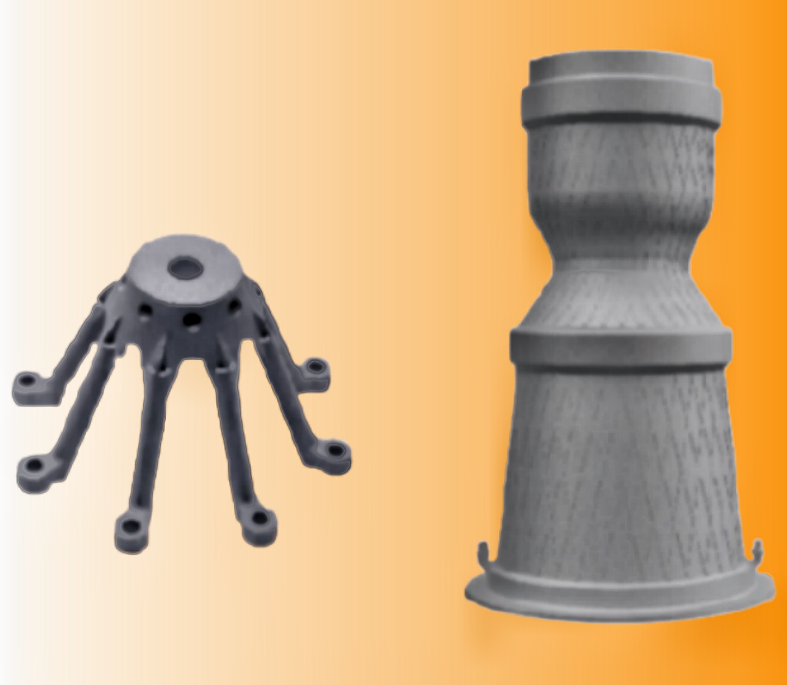
  • Fuel nozzles (e.g., GE’s 3D-printed nozzle reducing 20 parts to 1, 25% lighter)
  • Turbine blades with internal cooling channels
  • Lightweight structural brackets (up to 55% weight reduction)
  • Satellite components with integrated radio-frequency functions
  • Rocket engine combustion chambers. These additive-manufactured parts enhance fuel efficiency, reduce launch costs, withstand extreme temperatures (>1,000°C), and accelerate prototyping—critical for next-gen aircraft, reusable rockets, and deep-space missions.
How to bring solutions in aerospace technology?

Additive manufacturing is revolutionizing aerospace by enabling the production of next-generation components impossible through traditional methods. Engineered for extreme conditions, additive manufacturing allows layer-by-layer fabrication of geometrically complex parts with integrated functionality – from topology-optimized turbine blades with internal cooling channels to lightweight satellite brackets and fuel nozzles.

Frontier material’s alloy powders critically enable next-generation aerospace components by leveraging advanced additive manufacturing. Engineered for extreme performance, these powders facilitate the production of flight-critical parts such as turbine blades, combustion chambers, and lightweight structural elements.
RELATED CASES